Pre-K, Kindergarten, First, Second, Third, Fourth, Fifth, Sixth, Seventh, Eighth, Ninth, Tenth, Eleventh, Twelfth, Higher Education, Adult Education, Homeschooler, Staff - TeachersPayTeachers.com

National Rainbow Day April 3rd!

Hey, are you a teacher or mama/grandma that wants to enrich a little one or your students?  Well, let me tell you! National Rainbow Day is the perfect day to do all things rainbowy! Is that even a word??  

Actually any national holiday is a great way to bring something fun into your learning day!  I go back to school next week into my first grade classroom and am planning on kicking off our week with all things rainbow! I am really excited!

First we will make hats to wear throughout the day! You do not need a special template.  Just get some white paper, draw a rainbow and staple bands to the side and fit around to their head.  However, if you want a template, I have one here! Click on the picture!


Next, we plan to read books from the public library about rainbows! I will go pick out some books to take to our reading center in our classroom.  Also, there are many great choices for rainbow books you can search! I can't decided which ones to get.  I think I'll get them all up to my 30 count limit!


I love to teach phonics with a poem of the week and I wrote this little ditty... haha! I always tell my students I am a song writer, but really they are off the cuff and sometimes don't even rhyme! But with this one, I think I will teach them how to find the sounds in the middle of the words.   For example, I spy a word that has /e/ as the middle sound.  That's right! RED! Color the e in red, and so on. 

This one goes to the tune of Head and Shoulders, Knees and Toes. 


For our read aloud, I will read one of the books from the library and follow up with this mini book.  They will get a copy of the black and white copy to color.  They can then put this reader in their book tub to add to their quiet reading collection.


We will make this cute craft during arts and craft special! You can totally make this with cutting white strips to color the colors of the rainbow and put on a circular cut-out with cotton balls, but if you want the ease of a template, click on the picture below.


We will write about what we wish to find at the end of our magic rainbow.  Do you want to find candy? Do you want to find money?  Do you want to find toys? What do you want to find at the end of your rainbow? 


We will practice our spelling words in one of our language arts stations.


During math centers, we will have a scavenger hunt as one of our stations!


Another one of our stations will be a sight word station.  You can totally do this by writing your sight words or even spelling words on 3x5 cards.  Draw a rainbow and call out the words to place under their rainbow.  I will have 4-5 students in a group.  I will lay about 20 words on the table.  Each of them will have their own rainbow.  I call the one at a time to take turns.  Ella, find the word "them."  Ella will find the word and put it under their rainbow. This is not a game where anyone wins, but they love finding the word I call out.


In math, students will color the row according to what you say, "Color 21-30 orange!" If you have students that have little number sense start at 1 and only go to 20, or 30, depending on their level. Higher students can be given random places to start to practice their number sense. 


Morning work will be easy with these simple addition and/or subtraction worksheets.  Obviously, there is so much more than you will ever need in this packet, but I wanted to make sure there were plenty of choices for buyers to choose from for the perfect rainbow day!


This is one of my favorites! Place a cloud on the rainbow and have students identify tens and ones.  They can either just place the number or use place value blocks.  


If you have stayed with me through this entire blog, I have a fun freebie to go with your rainbow day! Most of your activities can be created with simple paper. but if you want the ease of templates, I would love to help you out.  However, click on the following picture for a freebie that is a small sample of the larger paid product. 


Thank you sooo much for hanging out with me and learning about how you can bring rainbow things into your learning or enrichment day! For more information, other products, freebies, and sales, please follow me on my Teachers Pay Teachers Store here! 


Addition and Subtraction Related to Counting

 Addition and subtraction are the two most basic operations in counting. In simple terms, it is just like moving forward and backward on a numbers line. 

The process of addition related to counting means the value is going forward on a number line.

The process of subtraction means the value is going back on a number line.

Teaching addition and subtraction related to counting is simply putting it on a number line and showing a student how to go forward or back on a number line. 

This process can also be taught by counting up or down if the number is small enough.

For example, addition for 3+2=  ___. Start with 3 and count up 2.  I like to teach my students to 'pound' on 3 and then count up two. 

For more information, you might check out this fun game that will help you teach your students or child this concept in a fun and engaging game!


Addition and Subtraction Related to Counting


Teaching how to add three whole numbers in your first grade classroom?

Are you looking to add fun to word problems?  

Here is how you can do it! Consider whole group or small group.

Offer up a problem that is relatable to them.  

Example: One day, Emma (use one of your students names) was walking home from school.  She saw 3 green bugs on the sidewalk, 4 yellow bugs on a leaf, and 2 white bugs on her front porch.  How many bugs did she see?

_______ + ________=__________

Give students some blocks to represent the bugs.  Give them white paper to draw the bugs and write a sentence.


If you want to save time, click on the picture to go to a resource that has what you need to bring fun into your classroom.

Adding Three Numbers First Grade Word Problems with Games and Response Worksheet to show thinking. There are 40 word problems with three number addition to use with a response sheet to show strategies or play a game. There is also a black and white version included.


👉Click on my store for more first grade curriculum!


Guided Reading Level A Books with 3 Activities for Young Students

My sweet student I will call "Bob" came over to the guided reading table to read with me.  When I open the level A book, he began to read the pictures, pretending to make up the story as he went along.  

Bob wants to read, but lacks the understanding of how print works and that there is a relationship between letters and how they connect together with sounds.  When I look through my 6 pack of readers, even the A levels seems to be a bit difficult for Bob.  After reviewing all the letters and sounds, it is time to start with guided readers. 

The first step is to teach Bob to move his finger from left to right across the page. Bob already realizes the pictures do have a connection to the story because he is reading the pictures! Celebrate!

The next step I will move Bob through is that there is a correlation from letters to words and how these words connect with the picture.  The words on each page are very predictable so that Bob will see these words repeated and have similar phrases on each page. 

We start with the first word.  I will break down that word one letter at a time.  For example, if the word is "Cat."  I will say, "Can you point to the first word?"  They point to cat.  

Teacher: What is that letter?

Student: C

Teacher: What does C say?

Student: /c/ making the hard c sound.  

Teacher: Great! What is the next letter?

Student: A

Teacher: What does A say?

Student: /a/ making short a sound.

Teacher: What is the next letter?

Student: T

Teacher: What does T say?

Student: /t/ making the /t/ sound.

Once the sounds are established, model the three sounds.  You said that C says /c/, A says /a/, and T says /t/.  Then say the sounds together. /C/A/T./  Cat! Have the student repeat the sounds.  

That may be all you work on that day, depending on how long that took.  Otherwise read until the child comes to a word that stumps them.  Break each word down.  

You might make a 3x5 card of the word CAT and have the student wear it around their neck, put it on their name tag for reference throughout the day, occasionally asking them what is that word as you randomly walk past their desk.  

This was an example of guided reading for one student.  But the process is the same if you work with 6 students.  You go around the table and work individually with each child that is at your table.  Have other students work on their copy of the same book, or if they finish, they may read one of the books they brought over while they wait for you to get to them.

Finding the activities and level A books to work with students at this level can be difficult.  My library consisted of only 2 level A books because publishing companies assume students coming into first grade should be reading at level C.  I needed more books and so I went to my computer to create level A books and activities to do with my students.

If you need books and activities, click on the pictures that will take you to this resource.  Please let me know if you have questions regarding teaching students that are reluctant to begin reading.  I would love to help you with ideas. 


If you have questions or are interested in more reading resources, click on the following link,


How to Teach 5+ Fun Comprehension Skills to Primary Students

Last year, I sat down at my guided reading table to work with a group of very good readers.  I usually have 4-6 readers at my table.  This particular group was 6 readers that could read at a level L.  As I opened the book up for discussion, there were great comprehension responses to the texts that "wowed" me as a teacher. 

However, there was one student that remained fairly quiet. I dismissed the other readers back to their seats and turned to the quiet student.  I asked him a simple comprehension question. He couldn't reply with an answer. I got that "deer in the headlight" look.  So, I decided I needed to zero in a little closer with him to see if there was an issue with comprehension.  I listened to him read a portion of the text again and then asked a few simple questions.  He couldn't give me an answer although he could read extremely fluently.  

This story replays often every year with fluent readers.  They can read anything you set in front of them, but cannot answer basic comprehension questions.  They have mastered the reading, but aren't thinking about the story or comprehending what they are reading.  

To be a good reader, students need to think about what they are reading. This actually takes a skill that sometimes has to be taught.  Students know they need to string letters together to make words, but sometimes they don't realize or understand that these words together have meaning.  It seems simple enough to children when this comes naturally, but a few strategies of reading comprehension will help those that this does not come naturally.  

Comprehension is thinking about what you are reading.  

There are several comprehension strategies that can be used to help students or young children begin to think about what they are reading. When introducing these strategies, I start with an anchor chart. This is the big paper that can be made into large posters to hang while you are studying a concept.  I place all of these on a comprehension wall that we refer back to over the course of the school year. At the end of the year, students often beg to take them home as souvenirs.

The strategies are taught for 2-3 weeks.

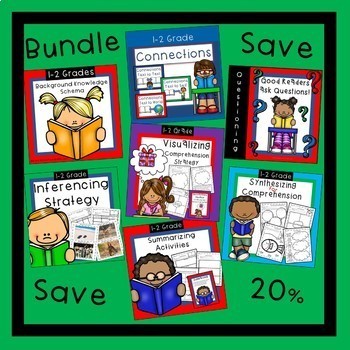
  • Connections

Connections are when you as the reader connect what you are reading to something else in your life.  Sometimes this is another book, text to text.  Sometimes, this is an event in your life, text to self. Sometimes this is a connection to something in your world, text to world. Examples of text to world are holidays, public events, or articles related to the book.  When I taught 3rd grade, I taught each of these connections for a week.  Now that I teach first grade, I usually linger on a strategy for 2-3 weeks.


  • Background Knowledge also known as Schema

Background knowledge is just simply what your readers already know about a subject.  Students may read a book about a birthday party and understand the context because they have had a birthday party or have been to a birthday party.  Similarly, if they read about a dog and have a dog, they will have schema or background knowledge about dogs, the subject they are reading. 


If students read about a wobbegong and have never seen a wobbegong, they wouldn’t have a clue about what they are reading, nor would I.  I had to look it up. No, seriously. I had to look it up.


In addition, I can’t pick up a neurosurgery book and understand what I am reading. I would lose interest pretty quickly because I don’t have the background knowledge for these areas.


  • Visualization

I teach this to young students as 'a movie in your head.'  We pop popcorn and drink mini sodas. I set up a mini movie theater background and put it behind me while I read a book. I don’t show them the pictures.  I ask them what they are visualizing.  I also give them a piece of blank paper and have them draw what they are seeing in their head. I repeat the term visualizing repeatedly to help them remember.  I might say, “What are you visualizing?” as they draw their pictures on clip boards. 


After the students have completed their drawing, I show them the illustrations to compare. Sometimes students have very similar ideas about what they are visualizing as the illustrator.  They love to compare their drawing to one another as well.


  • Inferencing

This skill is when you know something about the book that isn't written in words. 


For example, "My sister hit me really hard.  I turned and looked at her with a grimacing face.  My mom knew how I felt."

The text never says she is mad or hurt, but you can inference this because of the choice of words the author used.  As adults you inference when you read mystery novels or “who done it” books.


  • Questioning

This strategy can be taught by teaching students to ask questions about what they are reading.  Many times, we ask the questions and expect them to answer.  We forget to have students ponder, or wonder about their reading.  Ask them what they wonder or if they have questions about their reading. Give them time to think about their questions.  Even if they come up with outlandish questions or far-reaching questions, it is leading them in the direction of thinking about what they are reading.

For more help or information to teach the strategies, click here!

👉 Reading Comprehension Strategies Bundle


Comprehending reading will open new worlds of fun reading to your child or students.

For more information or companions and printables that will help you teach these comprehension strategies, visit  at Robin Wilson First Grade Love on Teachers Pay
Teachers.com.

You can teach this with books that you read with your students or with your child.  If you are interested, I have already created many book companions that follow this plan listed above.

Click on the pictures of these book companions that will help you teach comprehension strategies to save time.


Thank you so much for checking out these products! Visit
👉 Robin Wilson First Grade Love for more book companions to teach comprehension strategies!


9+ Activities to use with Room on the Broom Comprehension

Do you just love the book, "Room on the Broom?" It is one of my favorite books to read around Halloween.  I love to have the students get comfortable, pull up close on the rug, and listen as I read with all the voices of the characters! 

Get Ready for the First Week of Back to School for First grade


Are you ready for back to school night or that first week? Me either, but I am trying so hard to get ready.  I created some things that will help us get ready. Click on the picture for more information or read more below to help you get started. 


There was an Old Lady Who Swallowed BUNDLE Reading Comprehension Questions and Reading Strategies

Have you ever found yourself at a loss when trying to get your students engaged with reading comprehension questions? Or frustrated with th...